Cooling · open 24/7
Replacing a failed AC compressor in Philadelphia, PA
Outdoor unit humming but the compressor won't run? We prove the compressor itself has failed, then lay out whether a new compressor or a new system makes more sense.
- Phones answered 24/7
- Scroll and reciprocating compressors
Updated October 2026
- Common failures
- Shorted windings, seized motors, worn valves and bearings
- We test
- Winding resistance, amp draw, start parts and system pressures
- Decides it
- System age, refrigerant type and indoor coil condition
Short answer
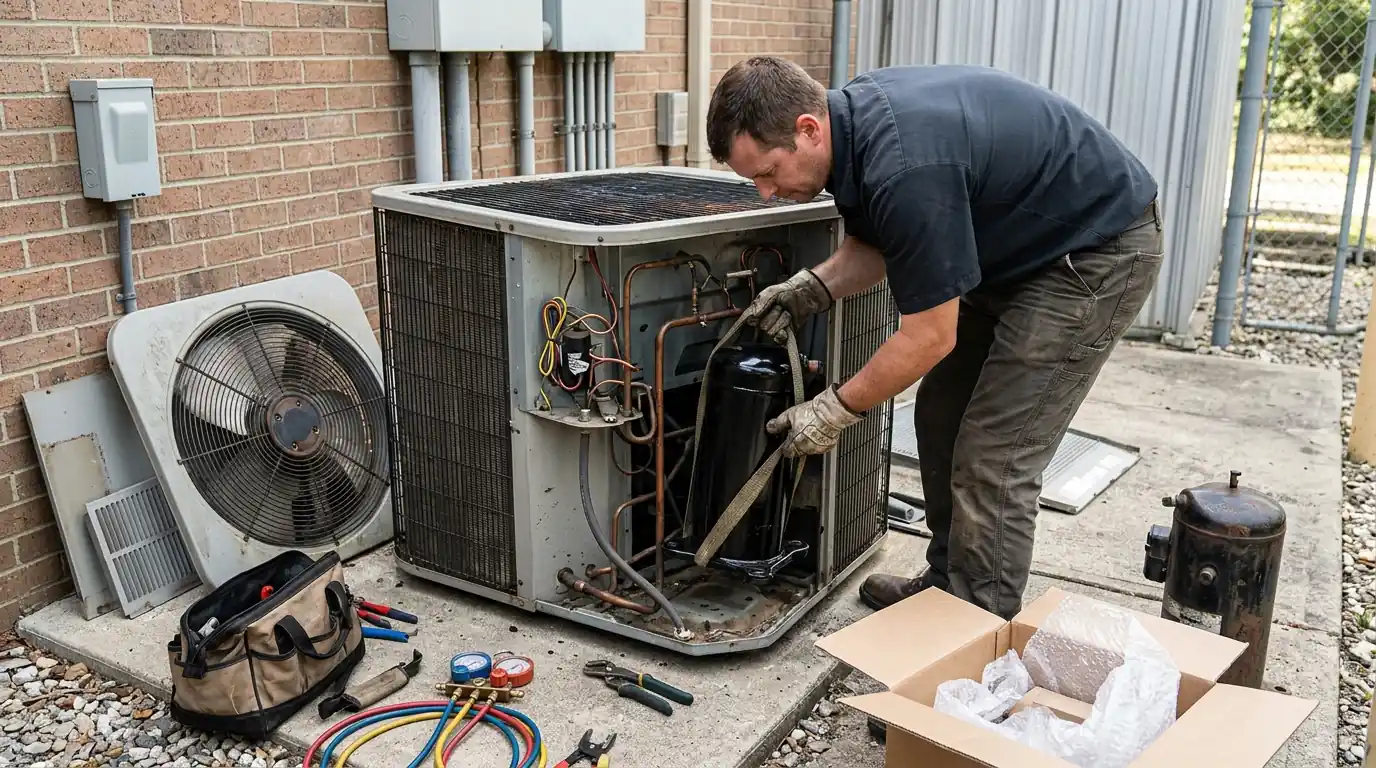
AC compressor replacement in Philadelphia, PA starts with proving the compressor actually failed. We test winding resistance, amp draw and the start parts, since a bad capacitor can mimic a dead compressor. If it is truly gone, we recover the refrigerant, braze in the new compressor and a filter drier, pull a deep vacuum and recharge by weight.
Is it really the compressor?
Plenty of condensers that sound dead have a good compressor inside. A swollen run capacitor, a pitted contactor or a tripped internal overload will stop a compressor cold, and those are small repairs. We check them before anyone says the word replacement, then measure the windings to ground and to each other.
When the compressor has failed, the next question is why. Compressors rarely die of age alone. Low charge, a restricted metering device, a dirty condenser coil baking on a roof or acid in the oil usually did the damage, and a new compressor fails the same way if that cause stays put.
What sets the price of a compressor job
You see the price before we start. What moves it:
- Compressor model, size and whether it has to be ordered
- Refrigerant type and how much charge the system needs
- Roof, yard or side-alley access to the condenser
- Extra parts like a filter drier, start kit or contactor
Before a compressor gets ordered
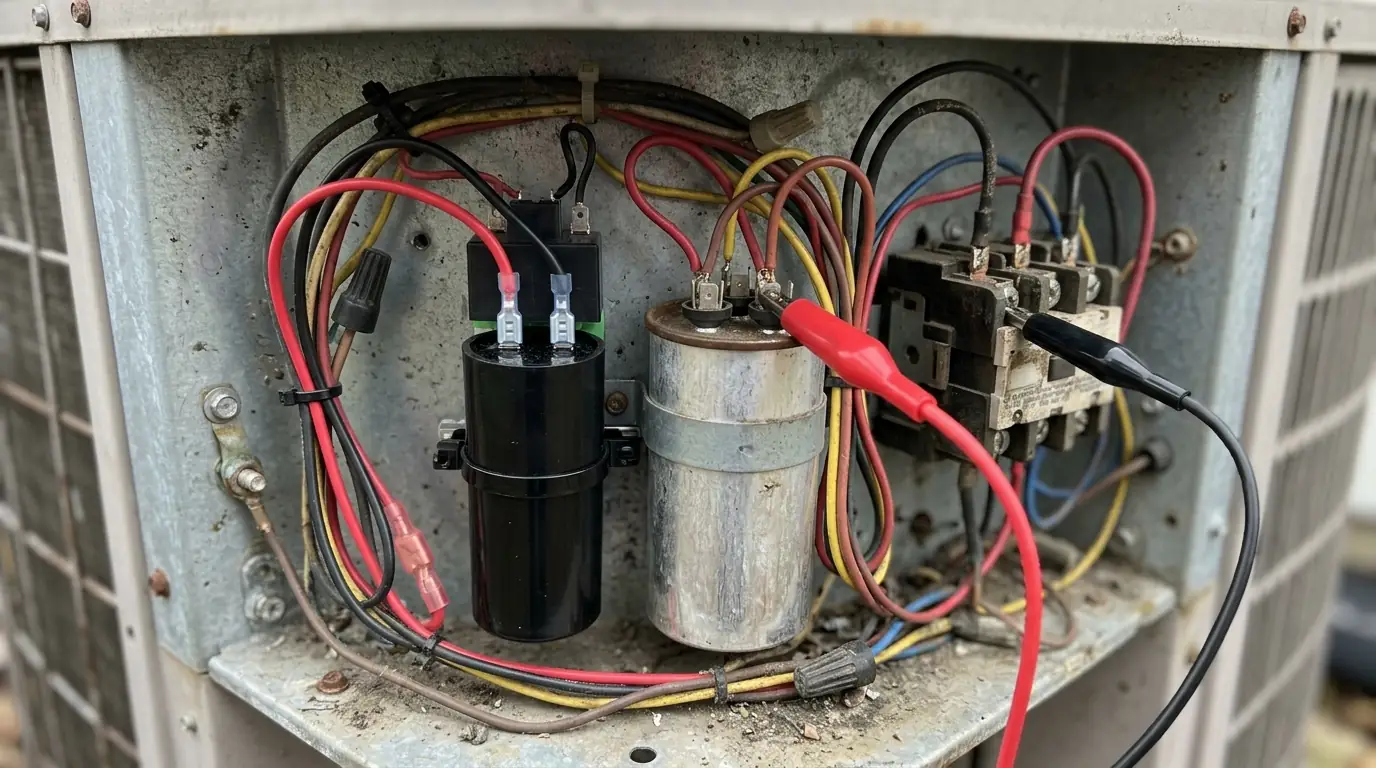
Hard-start kits
A compressor that hums, trips its overload and tries again a few minutes later is struggling to start against pressure. Sometimes the windings are fine and the motor just needs help getting going. A hard-start kit adds a start capacitor and a relay that give the compressor a short boost at startup, then drop out. We fit one only after the windings and amp draw check out, because a kit on a shorted compressor just delays the next call. It suits an older system you plan to replace soon. Other start-up faults are covered under AC repair.
Compressor or full system
A new compressor goes into the existing condenser and keeps the indoor coil, line set and refrigerant you already have. That makes sense on a newer system with a sound coil and no leak history. On an older system, especially one still running on R-22, the math usually changes: the refrigerant is scarce, the coil may be tired, and labor is a big share of any compressor swap. We look at the coil, the line set and the system's age, then price both paths side by side. A system that lost its charge first needs leak repair either way.
New compressor, new outdoor unit or a whole new system
Three ways forward once the compressor is confirmed dead, smallest job first.
| Option | Fits when | Trade-off |
|---|---|---|
| Compressor only | The system is fairly new, the coil is sound and nothing is leaking | Lowest parts cost, but recovery, brazing and evacuation labor still apply |
| New outdoor unit | The condenser cabinet or coil is worn but the indoor coil still matches | Fresh outdoor coil and fan, has to pair correctly with the indoor coil |
| Full system | The system runs on R-22, the coil leaks or the equipment is near the end | Largest job, with a matched coil and outdoor unit sized to the house |
From the first test to the restart
Test the electrical side
Capacitor, contactor, overload and winding resistance, so a cheap part is never mistaken for a compressor.
Find the cause
Charge, airflow, coil condition and oil acidity, so the new compressor does not fail the same way.
Recover and remove
The refrigerant is recovered to a tank and the old compressor is cut out cleanly.
Braze, test and evacuate
New compressor and filter drier brazed under nitrogen, pressure tested, then a deep vacuum confirmed on a micron gauge.
Charge and check
Refrigerant weighed in, then superheat or subcooling, amp draw and temperature split verified.
The 2025 refrigerant change and an older condenser
The EPA refrigerant mandate that took effect in 2025 changed the rules for new air conditioners, which matters when a compressor fails. For a compressor replacement, the working rule stays simple: the new compressor has to run on the same refrigerant the system already holds. On a rowhome with the condenser up on the roof and the coil in a top-floor closet or attic, that refrigerant question often decides whether repairing the old system or replacing it is the smarter plan.
How long a compressor swap takes
Most compressor replacements take a full working day once the part is on site. Recovering the charge, cutting out the old compressor, brazing under nitrogen, pressure testing and pulling a vacuum all take time that cannot be rushed.
Getting the part is often the longer wait. Compressors are specific to the model and refrigerant, and some have to be ordered. A condenser on a rowhome roof adds time when the old compressor has to be hoisted down.
- Carrier
- Trane
- Lennox
- Rheem
- Goodman
- York
- Bryant
- American Standard
- Mitsubishi Electric
- Daikin
- Fujitsu
- Weil-McLain
- Burnham
We replace compressors in central air systems from Carrier, Trane, Lennox, Goodman and Rheem, matched to the condenser's model and refrigerant.
Sound alone will not tell you, because a hum with no start can be either. We measure the capacitor first, then the compressor windings, before naming the failed part.
On a newer system with a sound coil, often yes. On an R-22 system or one with a leaking coil, a new system usually makes more sense.
Sometimes. Replacement compressors for R-22 systems can be hard to find, and the system still needs scarce R-22 to run. We price that against a new system first.
Usually something else in the system: low charge, a dirty condenser coil, a stuck fan motor, liquid refrigerant flooding back, or moisture and acid left behind after an earlier repair.
It can run for a while if the windings test fine. A kit helps a tired compressor start, but it does nothing about wear inside it.