Water Heaters & Home Repairs · open 24/7
Ceiling fan installation in Philadelphia, PA, braced and balanced
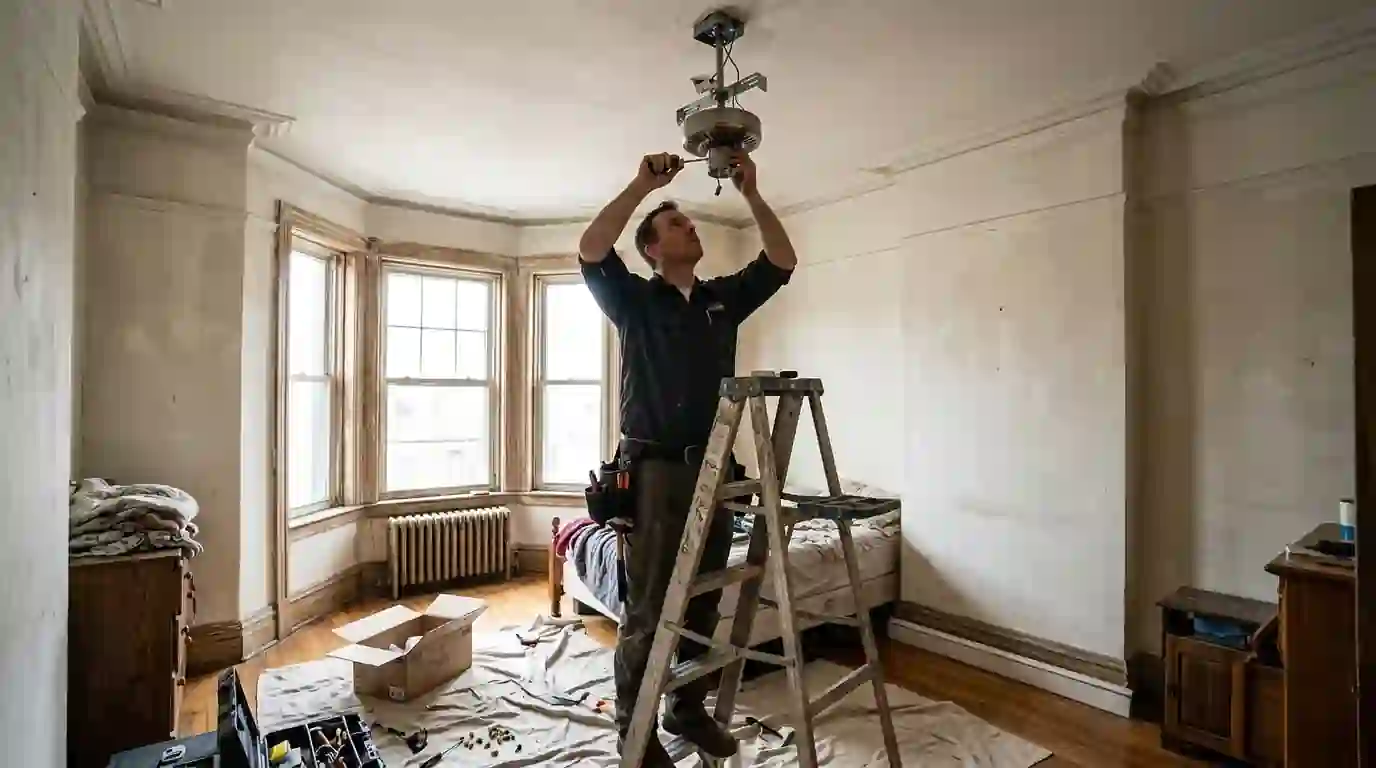
Want a fan where the old light hangs? We confirm the box can carry a fan, brace it if it cannot, wire the controls and balance the blades so it runs quietly.
- Phones answered 24/7
- Fan-rated boxes and braces
Updated October 2026
- Common jobs
- Light-to-fan swaps, new braces, remote or wall controls, downrods
- Checked first
- Box rating, wiring condition, ground and switch setup
- Answers
- 24 hours, 7 days a week
Short answer
Ceiling fan installation in Philadelphia, PA starts at the box, not the fan. A light fixture box is often not rated to carry a spinning fan, so we check for the fan-rated marking and add a brace between joists if it is missing, then wire, mount and balance the fan.
Why a ceiling fan needs more than a light fixture
A light fixture just hangs. A fan weighs more, spins, and pushes a constant small load back and forth on whatever holds it, which loosens screws in a box that was never made for it. That is why a wobbling or loose fan usually traces back to the box, and why we check it before anything else.
Wiring comes next. Older homes may have cloth-insulated wire, no ground, or a single switch leg feeding the light. If you want the fan and light on separate wall switches, that needs an extra conductor; otherwise a remote, or a wall control paired with a receiver in the canopy, handles it. We say which your ceiling allows.
What affects the price of a fan installation
You see the price before we start. What moves it:
- Whether the existing box is fan-rated or needs a brace
- Ceiling height, slope and the ladder or scaffold it takes
- Wiring for separate fan and light switches versus a remote
- A new location with no existing box or power
Ceiling fan jobs we handle
Replacing a light fixture
Most fan jobs start with an existing ceiling light, often in a bedroom that runs warm. We shut off the circuit, test it dead, and take the fixture down to see what is behind it: the box, how it is fastened, and the condition of the wire. Brittle cloth insulation near the box or a scorched splice from an old high-wattage bulb gets dealt with before any fan goes up. If one switch feeds the box, it powers both fan and light, and the pull chains or a remote split them.
Fan-rated boxes
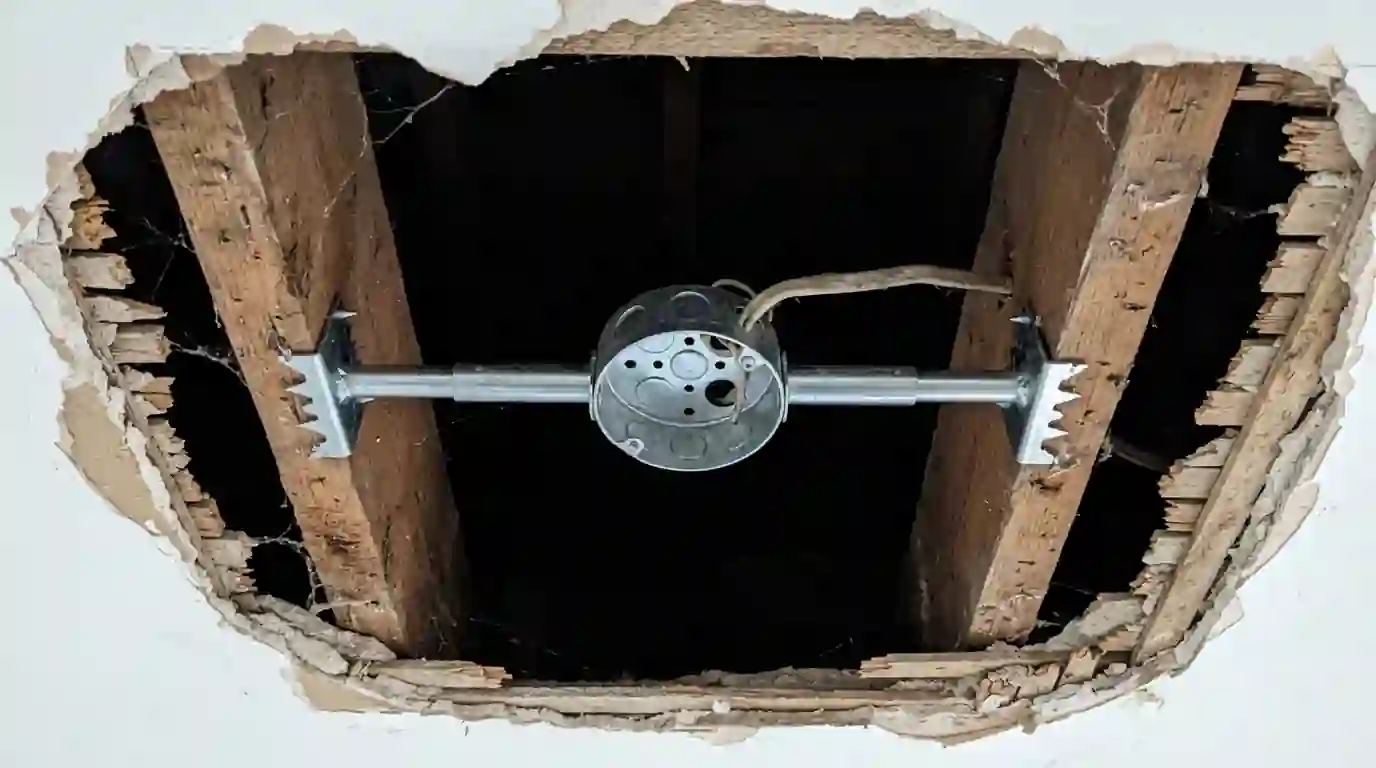
A box that can hold a fan is marked for fan support and fastened to framing, not hung from a plastic shell or a lath strip. Many older ceilings have a shallow metal pancake box screwed to lath, or a box nailed to one side of a joist. If the box is not rated, we fit an adjustable brace bar through the fixture hole, spread it between the joists, and mount a rated box to it, usually without opening the ceiling further. A wobble that never goes away after balancing is often a loose box, not the blades.
High and sloped ceilings
Tall ceilings in older houses need a longer downrod so the blades sit at a comfortable height, and manufacturers set a minimum blade height above the floor that we hold to. Sloped ceilings, common in top-floor rooms and additions, need a fan or adapter rated for the angle so the blades clear the ceiling at the low side. We bring the right ladder or scaffold for the height, and on very high ceilings we may suggest a remote so nobody needs to reach a pull chain. Stuffy top floor? See attic insulation.
How we hang a ceiling fan
Power off and test
We kill the circuit at the panel and confirm it is dead with a tester.
Check the box and wire
Fan rating, how the box is fastened, insulation condition, splices and ground.
Brace if needed
An adjustable brace goes in through the fixture hole and a rated box mounts to it.
Mount and wire
Fan hung on its bracket, wired to the switch or receiver, canopy secured.
Balance and test
Blades leveled and balanced, each speed and the light checked for noise and wobble.
What a ceiling fan installation covers
Every fan goes up the same way, whatever the brand.
- Circuit shut off at the panel and tested dead before the fixture comes down
- Box checked for a fan rating, with a brace bar added when it lacks one
- Wiring inspected for brittle insulation, loose splices and a ground
- Fan assembled, mounted and wired to the switch, remote or wall control
- Blades checked for level and balanced until the wobble is gone
- Every speed, the light and the reverse switch tested
- Packaging and the old fixture carried out of the room
Moving air in Philadelphia bedrooms that hold summer heat
Philadelphia summers are humid, and in older rowhomes the bedrooms upstairs often hold the day's heat well into the night. A ceiling fan does not lower the temperature; it moves air across your skin, which can let you set the air conditioning a few degrees higher. In houses without central air, a fan paired with a window unit or a ductless head spreads the cool air further. Switch it off when nobody is in the room, because it cools people, not rooms.
Fan checks you can do, and the ones to leave to us
Settings and cleaning are yours. Anything behind the canopy is ours.
| Safe for you to check | Leave for the tech |
|---|---|
| Setting the direction: counterclockwise in summer for a downdraft | Opening the canopy or touching the box wiring |
| Dusting blades so they stay balanced | Adding a brace or replacing a box |
| Tightening blade screws with the fan switched off | Running a new wire for a separate fan switch |
| Measuring ceiling height and room size before buying | Work from a ladder on high or sloped ceilings |
Yes, if power can be brought to the spot. We run a new cable from a nearby circuit and switch, which may mean small openings in the ceiling we patch afterward.
Usually a blade bracket that is bent or loose, blades of slightly different weights, or a box that moves. We check the mount first, then balance the blades with a kit.
On most fans, counterclockwise when you look up at it, so air is pushed down. In winter, reverse it on low to move warm air off the ceiling.
Only a fan listed for damp or wet locations, depending on where it hangs, and never as a substitute for an exhaust fan. A bathroom needs ducted exhaust to the outside to clear moisture.
Yes. Plaster is scored and cut slowly so it does not crack past the opening, the brace is fastened to the joists above, and any damage around the canopy is patched.