Water Heaters & Home Repairs · open 24/7
Gas and electric water heater repair in Philadelphia, PA
Cold shower, or water pooling under the tank? We find out whether it is a part, a fitting or the tank, and fix what can be fixed.
- Phones answered 24/7
- Gas and electric tanks
Updated October 2026
- Common fixes
- Thermocouples, gas valves, elements, thermostats, relief valves
- Covers
- Philadelphia and South Jersey
- Answers
- 24 hours, 7 days a week
Short answer
Water heater repair in Philadelphia, PA starts with telling a failed part from a failed tank. Thermocouples, gas valves, elements, thermostats and relief valves can be replaced. A tank leaking through its own steel cannot, so we find exactly where the water is coming from first.
Warning signs
When a water heater problem needs a call today
Water at the base of the tank
A fitting, the drain valve or the tank itself. Close the cold supply if it is spreading.
Pilot goes out again and again
Usually a thermocouple, a clogged flame arrestor or poor draft. Relighting alone fixes nothing.
Rotten egg smell near the heater
That is gas. Leave, and call the gas utility from outside. We come once it is safe.
Brown water or a sulfur smell from the hot tap
Rust means the tank is corroding inside. Sulfur usually traces to the anode rod reacting with the water.
How we decide between a new part and a new tank
A tank water heater is a simple machine, so most failures trace back to a short list of parts. On gas models: the pilot, thermocouple or flame sensor, gas control valve and venting. On electric models: two elements, their thermostats and the high-limit reset.
The tank decides everything else. Once the steel leaks, no repair holds, and we say so before ordering any part. If the tank is dry and sound, replacing the failed part is usually the sensible fix, and we show you the old one.
Water heater calls we take most
No hot water
On a gas heater, no hot water usually means the pilot is out or the main burner will not light. Look through the sight glass for a flame and check the gas control knob is on. On an electric heater, check the breaker. The high-limit reset sits behind live 240-volt wiring, so leave that to us. We test elements and thermostats, and on gas units measure thermocouple output and gas valve operation. If the tank itself is failing, water heater replacement is the honest answer.
Pilot will not stay lit
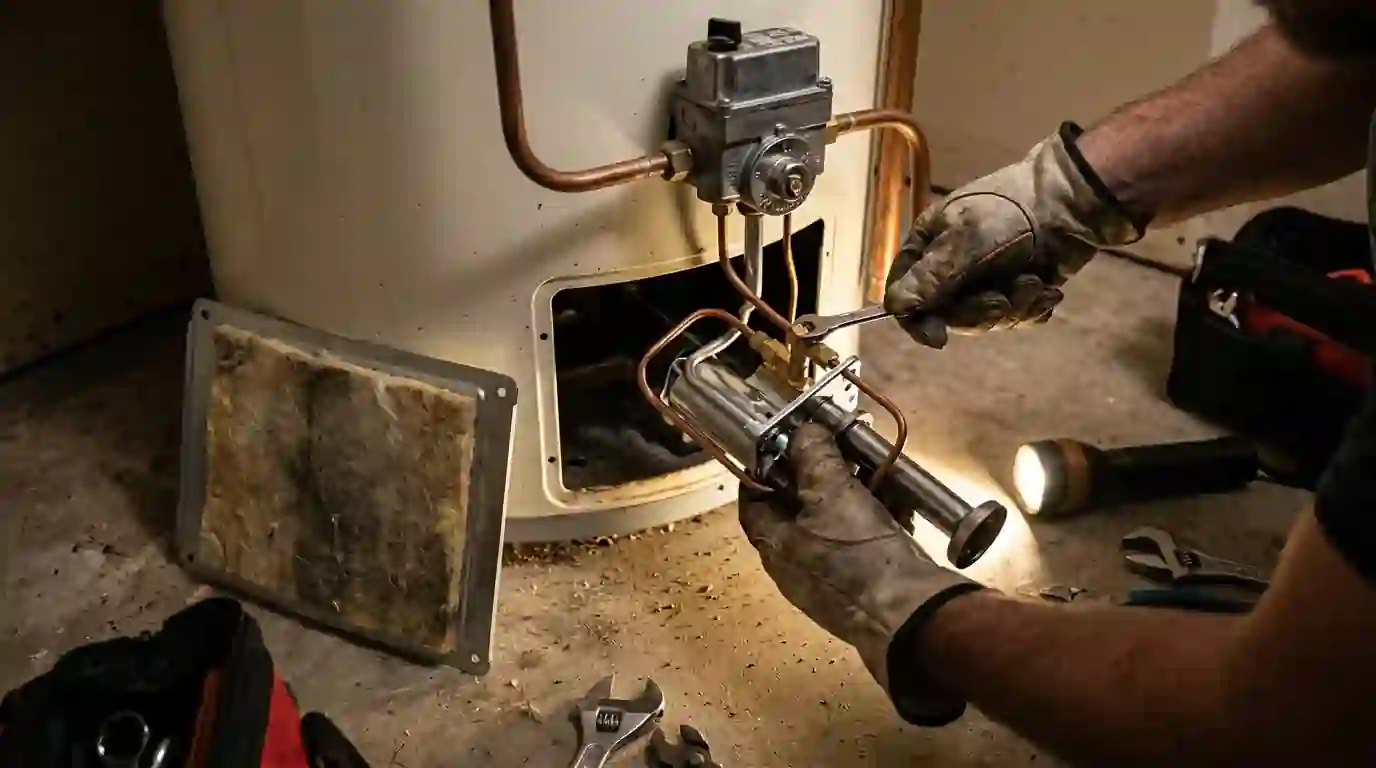
A pilot that lights, then dies the moment you release the button, almost always points to the thermocouple, the copper probe that tells the gas valve a flame is present. When it weakens, the valve shuts the gas off. Newer flammable-vapor-resistant heaters add a flame arrestor screen, and lint on that screen starves the burner of air. A downdraft from a blocked flue can blow the pilot out too. We test the thermocouple's output, clean the arrestor and burner, and check draft at the vent hood.
Leaking tank or leaking fitting
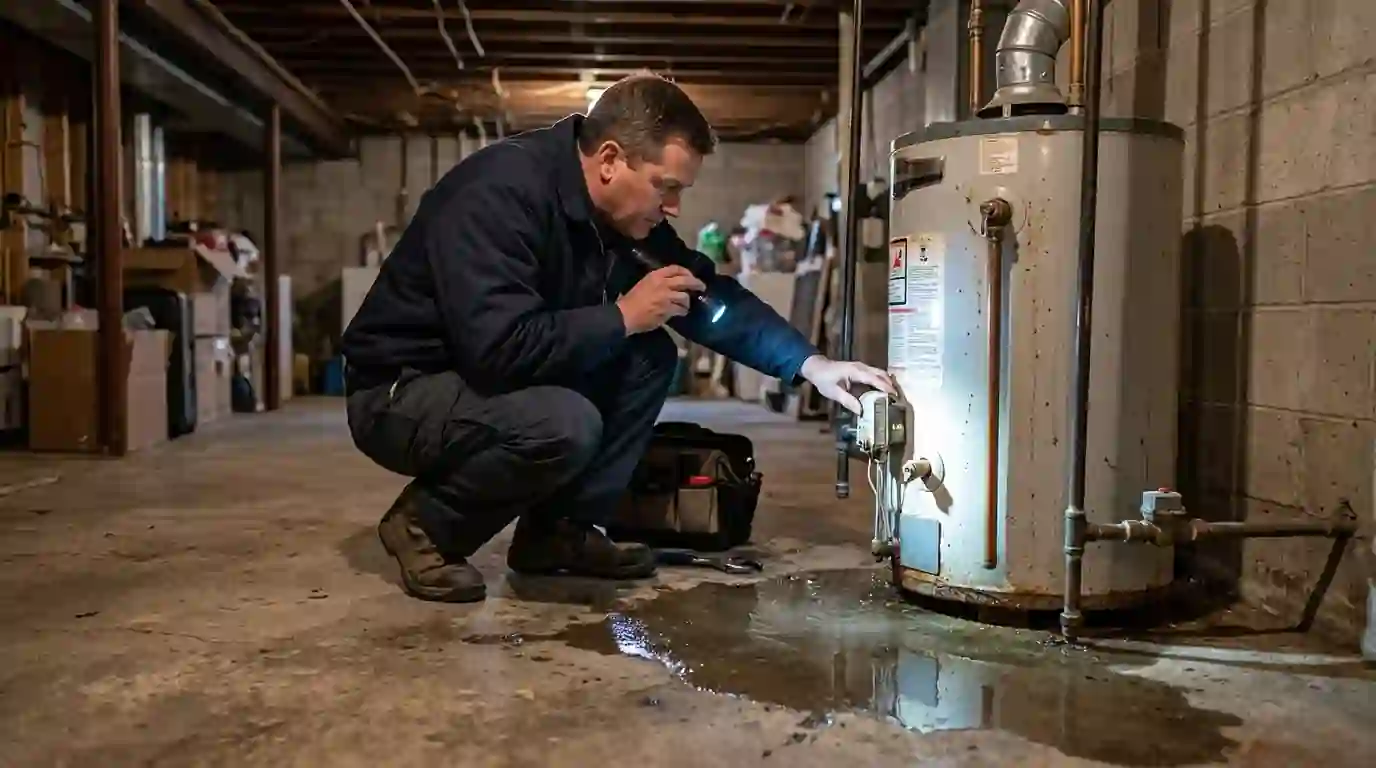
Most leaks are not the tank. Water can come from the connections on top, a weeping drain valve near the bottom, or the temperature and pressure relief valve. A dripping relief valve often means pressure is climbing on a closed system with no working expansion tank, not that the valve is bad. We dry everything, then trace the water to its source. Fittings, drain valves and relief valves can be replaced. Water seeping from under the jacket or the burner area usually means the tank has rusted through.
Rumbling and popping
Rumbling and popping from a gas tank is sediment. Minerals settle on the bottom, water gets trapped under that layer, and it flashes to steam as the burner fires. On electric heaters, scale crusts over the lower element instead. Flushing helps while the layer is loose. On an older tank with hardened buildup, flushing clears little and can clog the drain valve, so we judge age and condition first. We drain and flush the tank, replace a clogged drain valve, and swap a scaled element when needed.
Keeping older Philadelphia water heaters going
WHYY reported that old homes and high poverty make Philadelphia housing less affordable for some residents. For many households here, a dead water heater is an unplanned bill on a house that already needs work. So we test before we sell anything. A thermocouple, element or relief valve on a dry, sound tank is a repair, and we say so. When the tank leaks, we show you what we found and price the replacement plainly.
What happens on a water heater service call
Ask what changed
When the hot water stopped, any leaks, smells or noises, and the heater's age.
Check the tank first
Rust, seepage and the manufacture date, before we test any parts.
Test the suspect part
Thermocouple, elements, thermostats, gas valve or relief valve, depending on the symptom.
Repair and refill
Replace the part, refill the tank, purge air and bring it up to temperature.
Check venting and safety
On gas units we confirm the flue draws and the relief line is intact.
Safe checks before you call about no hot water
Try these first. Stop at anything involving gas, wiring or hot valves.
| Safe for you to check | Leave for the tech |
|---|---|
| The breaker for an electric heater | The reset button and anything behind access panels |
| A pilot flame showing through the sight glass | Relighting a pilot that keeps going out |
| Gas control knob set to on, not vacation | Gas valve, thermocouple and flue repairs |
| Closing the cold supply valve if water is spreading | Draining a hot tank or changing the relief valve |
What sets the price of a water heater repair
You see the price before we start. What moves it:
- Which part failed: a thermocouple is small, a gas control valve is bigger
- Gas or electric, and whether the part is model-specific
- Whether the tank has to be drained for the repair
- Access in a tight basement or closet
- Carrier
- Trane
- Lennox
- Rheem
- Goodman
- York
- Bryant
- American Standard
- Mitsubishi Electric
- Daikin
- Fujitsu
- Weil-McLain
- Burnham
We repair water heaters from A. O. Smith, Bradford White, Rheem, Navien and Rinnai.
If the water comes from a fitting, the drain valve or the relief valve, yes. If it seeps from the tank body, the heater needs replacing.
Often tank pressure is climbing, from high street pressure or a closed system with no working expansion tank. The valve may be fine. We measure first.
Not if it keeps going out. That points to a weak thermocouple, a clogged flame arrestor or a venting problem, which should be fixed first.
Once a year is a common rule, more often where the water leaves heavy scale. A tank flushed from the start stays quieter.
Yes. Tankless units show error codes for ignition, flow and venting faults, and many problems start with scale in the heat exchanger.