Commercial · open 24/7
Rooftop package unit repair and replacement in Philadelphia, PA
Rooftop unit limping along, or past repairing? We repair gas-electric and heat pump package units, fix economizers, and plan replacements on the existing curb when a unit is done.
- Phones answered 24/7
- Gas packs and heat pump packages
Updated October 2026
- Common fixes
- Belts, bearings, contactors, inducers, ignition, condenser fans, economizer actuators
- Replacements
- Matched to the curb, gas, power and duct openings
- Answers
- 24 hours, 7 days a week
Short answer
Rooftop unit service in Philadelphia, PA means repairing the package unit on your roof, or replacing it once repairs stop making sense. We base that call on the heat exchanger, the compressor, the cabinet and the curb. A gas pack with a cracked heat exchanger, or an old unit with a failed compressor, is usually a replacement.
Repair or replace: what decides it on a rooftop unit
A rooftop package unit holds everything in one cabinet: compressor, condenser coil, evaporator coil, blower and, on a gas pack, the burners and heat exchanger. Sun, rain and roof grit work on that cabinet all year, so rust, loose panels and corroded wiring are part of every inspection.
Most repairs are routine parts. Replacement comes up when the heat exchanger cracks, the compressor fails on an older unit, or the base pan has rusted through. We show you what we found and price both paths when both are reasonable.
What moves the price of rooftop work
You see the price before we start. What moves it:
- Repair versus full replacement
- Whether the new unit fits the old curb or needs an adapter
- Crane size and street access for the lift
- Gas, electrical and duct changes at the curb
Rooftop work we take on
Rooftop unit repair
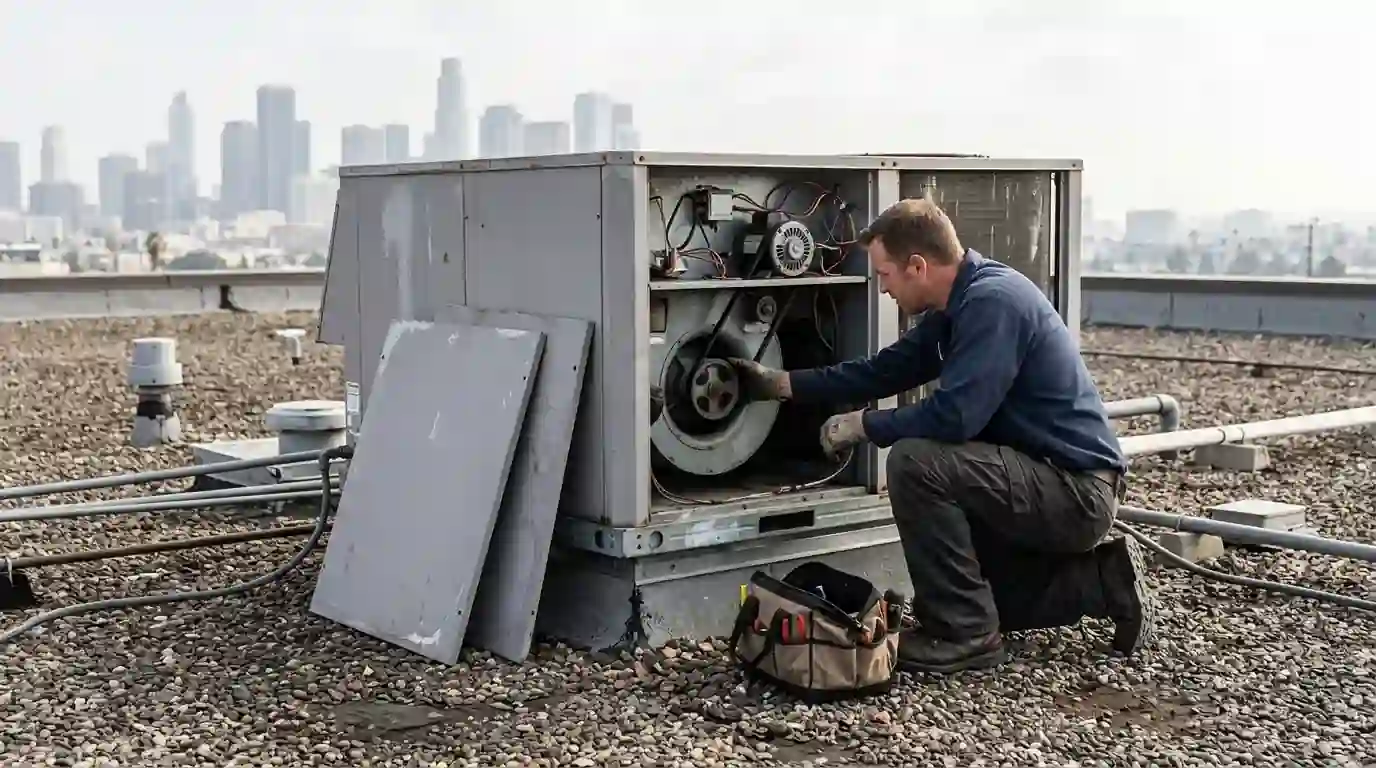
The repairs we make most on rooftop units are wear items: a burned contactor, a weak capacitor, a slipping or snapped blower belt, dry blower bearings, a failed inducer motor, or a condenser fan motor that quit in the heat. On the heating side, gas packs lock out on flame sensors, ignitors and rollout switches. We test the circuit that failed, inspect the heat exchanger whenever the burner compartment is open, and look for the root cause, such as rainwater getting into the control box. See commercial HVAC repair.
Rooftop unit replacement
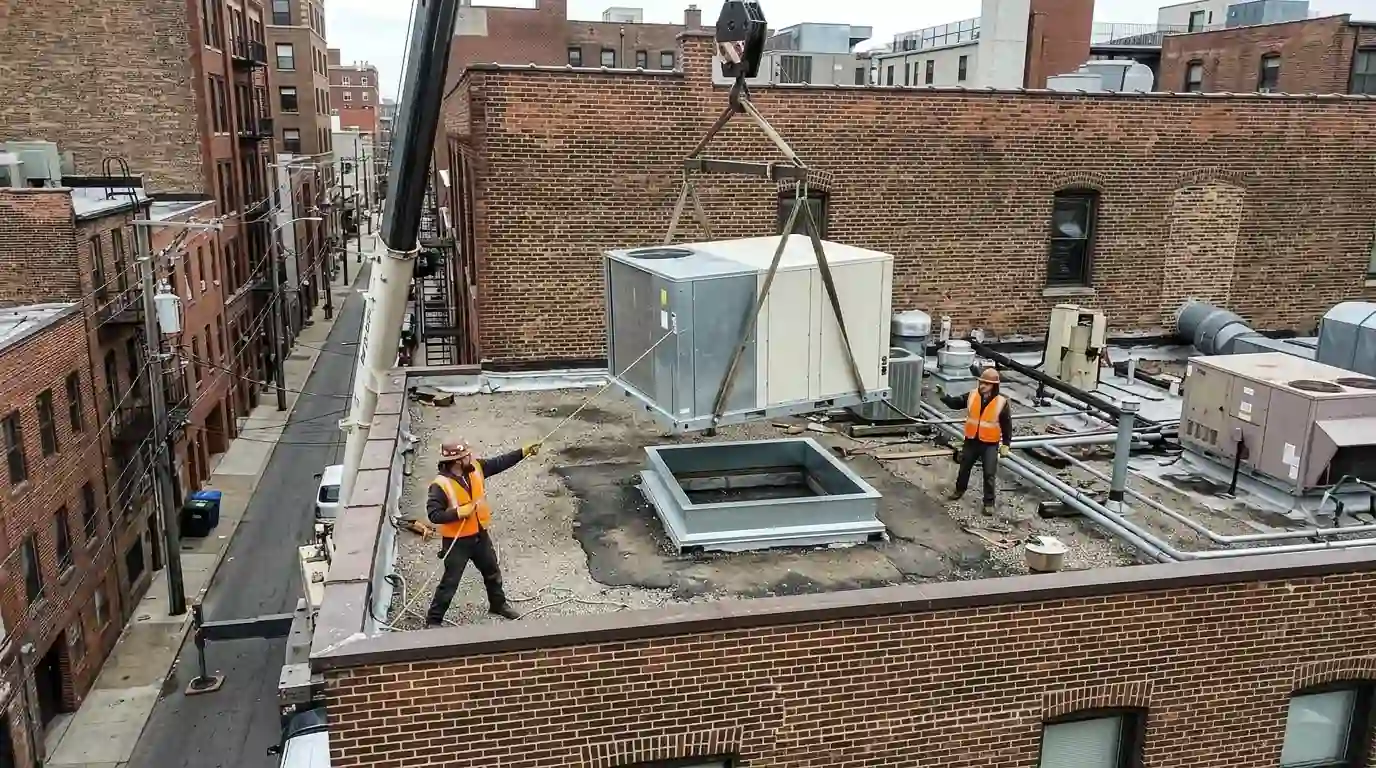
Replacing a rooftop unit is a lift and a reconnection. We confirm cooling tonnage and heat output against the space, then check whether the new unit's footprint and duct openings match the existing curb. If they do not, a curb adapter bridges the difference without cutting the roof deck. The job covers shutting off gas and power, the crane lift, setting the unit, reconnecting, sealing at the curb, and a full startup on heating and cooling. We pull the permit the work requires and set the lift date with you.
Economizers
An economizer lets a rooftop unit use cool outdoor air instead of the compressor on mild days. It is a motorized damper, an actuator, a controller and one or more sensors. When it fails open, the unit pulls in humid air in summer and cold air in winter, so the space misses setpoint and the equipment runs longer. When it fails closed, the building loses outdoor-air cooling and fresh air. We test the actuator, sensor readings and linkage, then repair it, replace the controller, or set the damper to a safe fixed position.
Three ways forward for a worn rooftop unit
How we lay out the choice when a rooftop unit needs major work.
| Option | Fits when | Trade-off |
|---|---|---|
| Repair the failed part | Heat exchanger, compressor and cabinet are still sound | An older unit may need another repair soon |
| Replace on the existing curb | The new unit's footprint matches the curb and duct openings | Needs a crane lift and a planned shutdown |
| Replace with a curb adapter | The new unit's footprint differs from the old curb | Adds an adapter and more work at the curb |
From roof survey to startup
Survey the roof and unit
Model plate, curb condition, roof access, gas and power, and how the unit runs now.
Lay out the options
Repair, a matching replacement or an adapter, each priced before anything is ordered.
Plan the lift
Crane, street access and a shutdown window agreed with you and the building.
Set and reconnect
The unit goes on the curb, then gas, power, ductwork and the condensate drain are reconnected.
Start up and test
Heating and cooling stages, economizer, airflow and safeties checked before we leave the roof.
Rooftop units on Philadelphia's older commercial blocks
In Philadelphia a lot of commercial space sits in older buildings, with storefronts at street level and a flat roof above. Rooftop units on those roofs often went up long after the building did, set on curbs cut into an old roof deck. That history matters at replacement time, so we check the curb, the roofing around it and the framing under it before a heavier unit goes up. Getting a crane onto a narrow city street also takes planning with the business and its neighbors.
How long a rooftop unit job takes
Repairs with common parts, like belts, contactors, capacitors and ignition components, are usually done on the first visit. Model-specific motors, control boards and compressors may need to be ordered first.
A replacement is scheduled around the new unit's delivery and the crane. The lift itself goes quickly. Reconnection, curb sealing and startup take longer, and an adapter adds more work at the curb.
- Carrier
- Trane
- Lennox
- Rheem
- Goodman
- York
- Bryant
- American Standard
- Mitsubishi Electric
- Daikin
- Fujitsu
- Weil-McLain
- Burnham
We repair and replace package units from Carrier, Trane, Lennox, York, Rheem and Goodman on commercial roofs.
Common signs are a cracked heat exchanger, a failed compressor on an older unit, rust through the base pan, or repairs coming back every season. We show you what we find.
Often, if the footprint and duct openings line up. When they do not, a curb adapter connects the new unit to the existing curb without reworking the roof deck.
Almost always. Package units are too heavy to carry up a ladder or through a hatch. We plan the crane, the lift and street access with you ahead of time.
It brings in outdoor air for ventilation and for cooling on mild days. A stuck damper wastes energy and can leave the space humid or cold, so it is worth checking.
It fits some buildings. We compare your gas service, electrical capacity, heating load and how the space is used, then explain the trade-offs before you decide.