Cooling · open 24/7
Evaporator coil replacement for central air in Philadelphia, PA
Topping off refrigerant every summer? That usually points to a leaking indoor coil. We find the leak, match a replacement coil to your outdoor unit and install it properly.
- Phones answered 24/7
- Cased, uncased and slab coils
Updated October 2026
- Usual reason
- Pinhole leaks from corrosion in the coil tubing
- Matched to
- Outdoor unit size, refrigerant and metering device
- Sits
- On the furnace, inside the air handler or in the attic
Short answer
Evaporator coil replacement in Philadelphia, PA usually follows a leak that has been traced to the indoor coil. We confirm the leak first with an electronic detector or a bubble test, then replace the coil with one matched to your condenser's size and refrigerant, braze it in under nitrogen, pull a vacuum and recharge the system by weight.
Why indoor coils fail in older houses
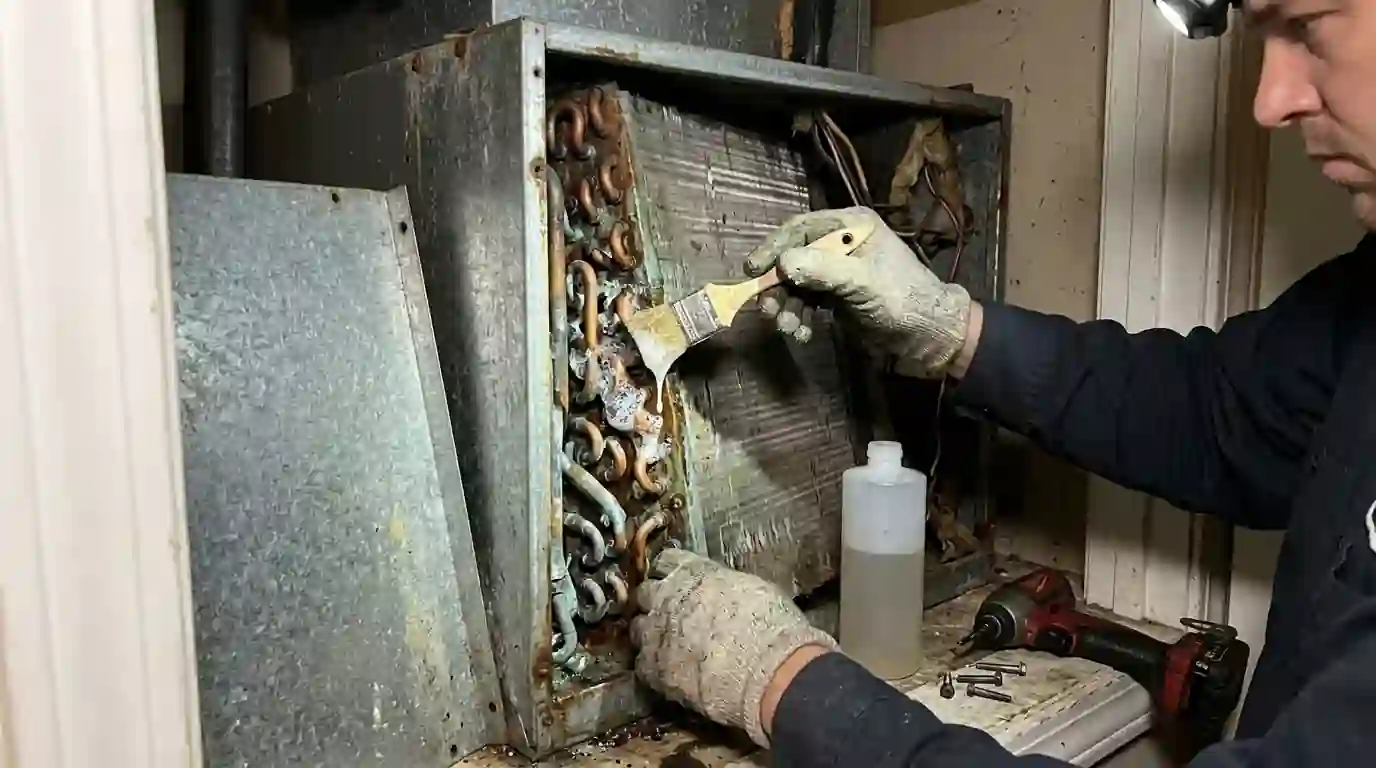
The evaporator coil is the cold part of central air, the coil on top of the furnace or inside the air handler that pulls heat and moisture out of the air. Most coils we replace fail from formicary corrosion, tiny pinholes that eat through the copper tubing and let refrigerant seep out slowly.
A coil can also fail from the outside in. A cracked drain pan rusts the cabinet, a matted coil face starves airflow, and a coil that freezes over and over gets stressed at the bends. We look at why yours failed so the new one lasts longer.
What moves the price of a new coil
You see the price before we start. What moves it:
- Coil size, style and the refrigerant it is built for
- Basement, closet or attic location and access
- A new drain pan, transition or plenum changes
- Refrigerant needed to recharge the system
What decides the coil job
Leaking coils
The signs build slowly: weaker cooling each summer, ice on the suction line, a system that needs refrigerant added season after season. We do not top it off and walk away. We search the coil with an electronic detector or bubbles, and on stubborn leaks we isolate the coil and pressure test it with nitrogen. A leak at a reachable joint or valve core can be repaired. Pinholes spread through the tubing call for a new coil, since patching one usually exposes the next. When the leak turns out to be elsewhere, our refrigerant leak repair page covers that work.
Matching the coil to the condenser
A coil is not a universal part. It has to match the outdoor unit's tonnage and refrigerant, and its metering device, a fixed piston or an expansion valve, has to suit the condenser. A mismatched coil can run, but capacity drops, dehumidification suffers and the compressor works under the wrong pressures. We read the condenser's model plate, then choose a coil rated to pair with it. When the outdoor unit is old and the coil is its second big failure, we talk through a full system replacement before anything is ordered.
Cased and uncased coils
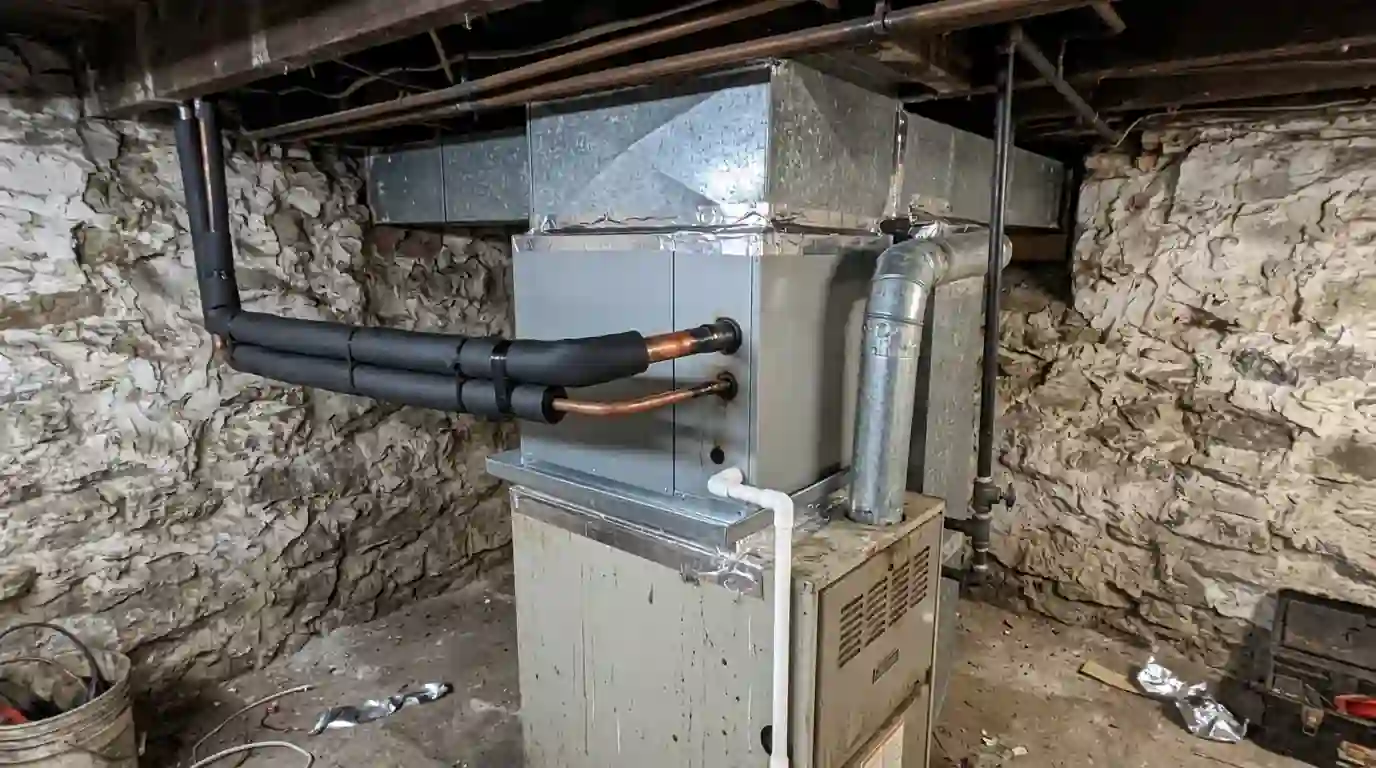
A cased coil arrives in its own sheet metal cabinet and sits on the furnace like a box. An uncased coil slides into an existing plenum, which saves height in a basement with low joists but means fitting it to whatever metal is already there. Slab coils lie flat in horizontal air handlers, often in attics or above closet ceilings. We measure the furnace width, the plenum and the headroom before choosing a style, and we seal the cabinet so air passes through the coil, not around it, which is where a lot of older installs lose capacity.
Repair the coil, replace it, or replace the system
How we weigh the choice once the leak is found in the coil.
| Option | Fits when | Trade-off |
|---|---|---|
| Repair the leak | One leak at a joint, valve core or service port | Least work, but only when the coil itself is sound |
| Replace the coil | The coil has pinholes but the condenser is newer and healthy | Restores the system, coil has to match the outdoor unit |
| Replace coil and condenser | The condenser is old, runs R-22 or has its own problems | Larger job, both halves new and matched at once |
How a coil replacement runs
Confirm the leak
An electronic detector, bubbles or a nitrogen pressure test isolates the leak to the coil.
Match the coil
Condenser model, tonnage and refrigerant checked so the new coil pairs correctly.
Swap and braze
Refrigerant recovered, old coil out, new coil brazed in under nitrogen with a new filter drier.
Test and evacuate
Standing pressure test, then a deep vacuum held and confirmed on a micron gauge.
Charge and verify
Charge weighed in, then superheat or subcooling and temperature split checked on a full cycle.
Coils, refrigerants and the 2025 changes
Industry experts described 2025 as bringing big changes to air conditioning units, and the indoor coil sits right in the middle of that. A replacement coil has to suit the refrigerant already in the outdoor unit, so we check the condenser's plate before ordering. In Philadelphia rowhomes, the coil is often perched on a basement furnace under low joists or packed into a closet air handler on an upper floor, and both spots shape which coil will physically fit.
What to expect on install day
A coil replacement on a basement furnace usually fills most of a working day. Recovery, brazing, a nitrogen pressure test and a proper vacuum take most of that time, and the vacuum step is never skipped.
Attic and closet air handlers can take longer because of tight access and a drain pan that may need replacing too. If the coil has to be ordered, we tell you the wait before scheduling the swap.
- Carrier
- Trane
- Lennox
- Rheem
- Goodman
- York
- Bryant
- American Standard
- Mitsubishi Electric
- Daikin
- Fujitsu
- Weil-McLain
- Burnham
We replace coils on systems from Carrier, Trane, Lennox, Goodman, York and American Standard, matched to the outdoor unit.
Sometimes, when the leak sits at a single joint or fitting. Pinhole corrosion across the tubing usually means replacement, because sealing one spot rarely stops the coil from leaking again.
Not always. If the condenser is newer and uses the same refrigerant, a matched coil is enough. An older R-22 condenser usually changes that answer.
Usually, if the width and height work. We measure the furnace and plenum first and add a transition when the sizes do not line up.
Low refrigerant, a dirty filter, a matted coil face or a weak blower are the usual causes. Fixing those early can save a coil from failing before its time.
We do not rely on them. Sealants can clog metering devices and recovery equipment, and they rarely hold on a coil with spreading corrosion.