Commercial · open 24/7
Commercial heating and cooling repair in Philadelphia, PA
Dining room hot, office cold, or tenants without heat? We repair rooftop units, split systems and boilers in restaurants, shops, offices and apartment buildings. A person answers the phone 24/7.
- Phones answered 24/7
- Rooftop units, splits and boilers
Updated October 2026
- Common fixes
- Contactors, capacitors, belts, ignition, compressors, economizer dampers, controls
- Buildings
- Restaurants, storefronts, offices, churches and apartment buildings
- Answers
- 24 hours, 7 days a week
Short answer
Commercial HVAC repair in Philadelphia, PA starts with the equipment that runs the building: rooftop units, split systems, makeup air units and boilers. We check incoming power, controls, ignition and the refrigerant circuit, find the failed part and repair it. On three-phase units we measure every leg, because a lost phase can burn out a compressor.
Warning signs
Problems that should not wait until closing time
Blower runs, but the air is warm
The compressor or condenser fan has dropped out while the indoor blower keeps moving room air.
Space drifting far from setpoint
A room that never reaches the thermostat setting points at a failed stage, a stuck damper or a control fault.
Breaker trips on startup
Repeated trips usually mean a shorted compressor, a failing motor or loose power wiring. Stop resetting it.
Water through the ceiling tile
A plugged condensate drain or a cracked pan on a rooftop unit can soak tiles and stock below.
What a commercial repair call looks like on the roof
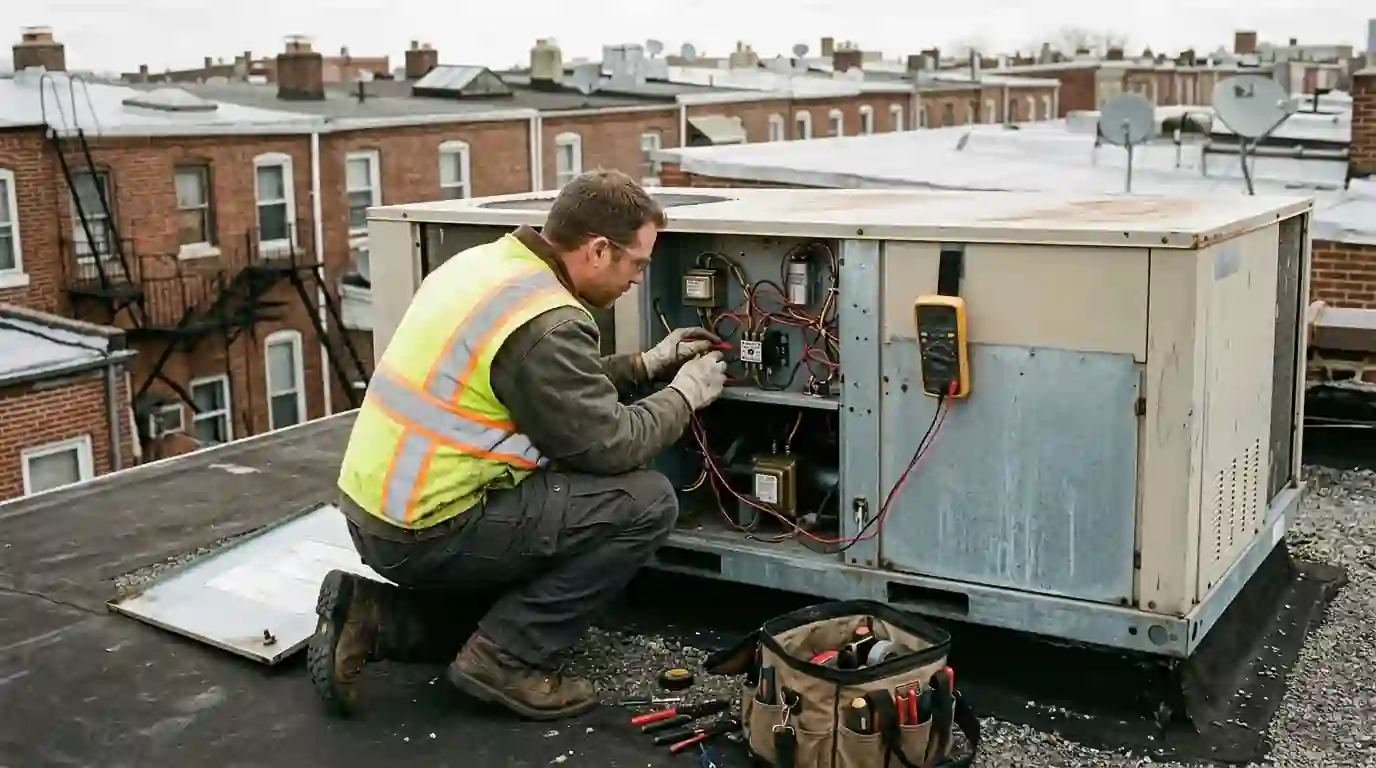
Small commercial buildings mostly run on rooftop package units, split systems or a boiler in the basement. A repair starts with the basics: power at the disconnect, the call from the thermostat or controller, filters and belts. A good share of service calls end right there.
When the basics check out, we test the circuit that failed: ignition and flame proof on the heating side, pressures, superheat and compressor amperage on the cooling side. Before parts are ordered, we explain what failed and whether the unit is worth the repair.
Buildings we repair in
Restaurants
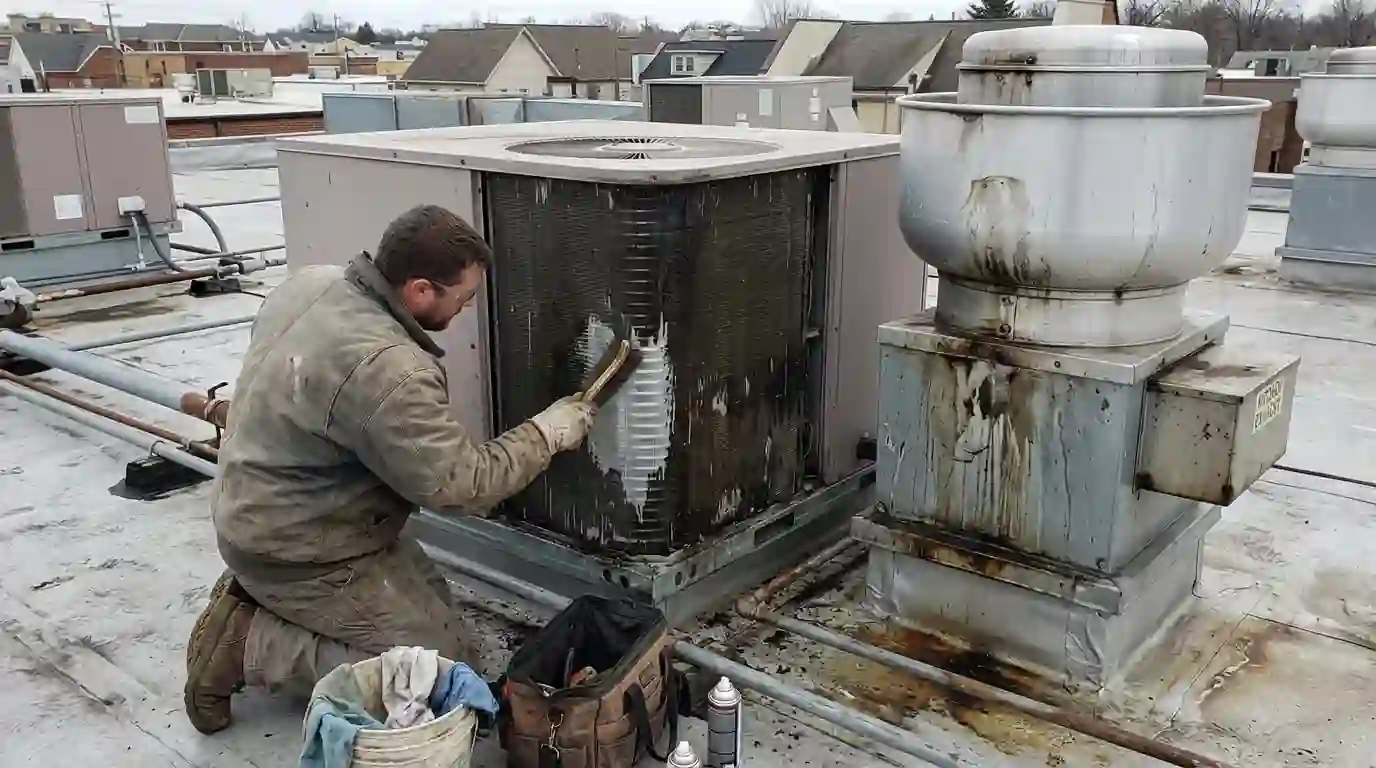
Kitchens are hard on HVAC. Grease from the hood exhaust settles on rooftop condenser coils, head pressure climbs, and the compressor trips during the dinner rush. If the makeup air unit stops, the kitchen goes negative, doors pull hard and the hood is starved of air. We degrease coils, check the interlock that starts makeup air with the hood fan, and measure compressor amperage under load. A unit tripping on high pressure often needs a cleaning, not a compressor. For the boxes in back, see walk-in cooler repair.
Offices and retail
Offices and storefronts usually run on one or more rooftop units or splits with a programmable thermostat or a small controller. Typical calls: one zone hot while the rest are fine, a unit running all night because its schedule was lost in a power outage, or muggy air because the economizer damper is stuck open. We check the schedule and the damper first, then the refrigerant circuit. Shops with heavy door traffic and lighting load run their units hard, so worn belts and weak capacitors show up early. See rooftop unit service.
Apartment buildings
In apartment buildings the complaint comes from tenants, and the cause can sit in the basement or on the roof. Older buildings often heat with a central boiler, steam or hot water, while cooling comes from separate splits, through-wall units or condensing units on the roof. When one apartment is cold and the rest are warm, we look at that unit's radiator valve, zone valve or vent before the boiler. When the whole building is cold, the boiler is the first stop. See commercial boiler service.
From West Deptford to South Philadelphia storefronts
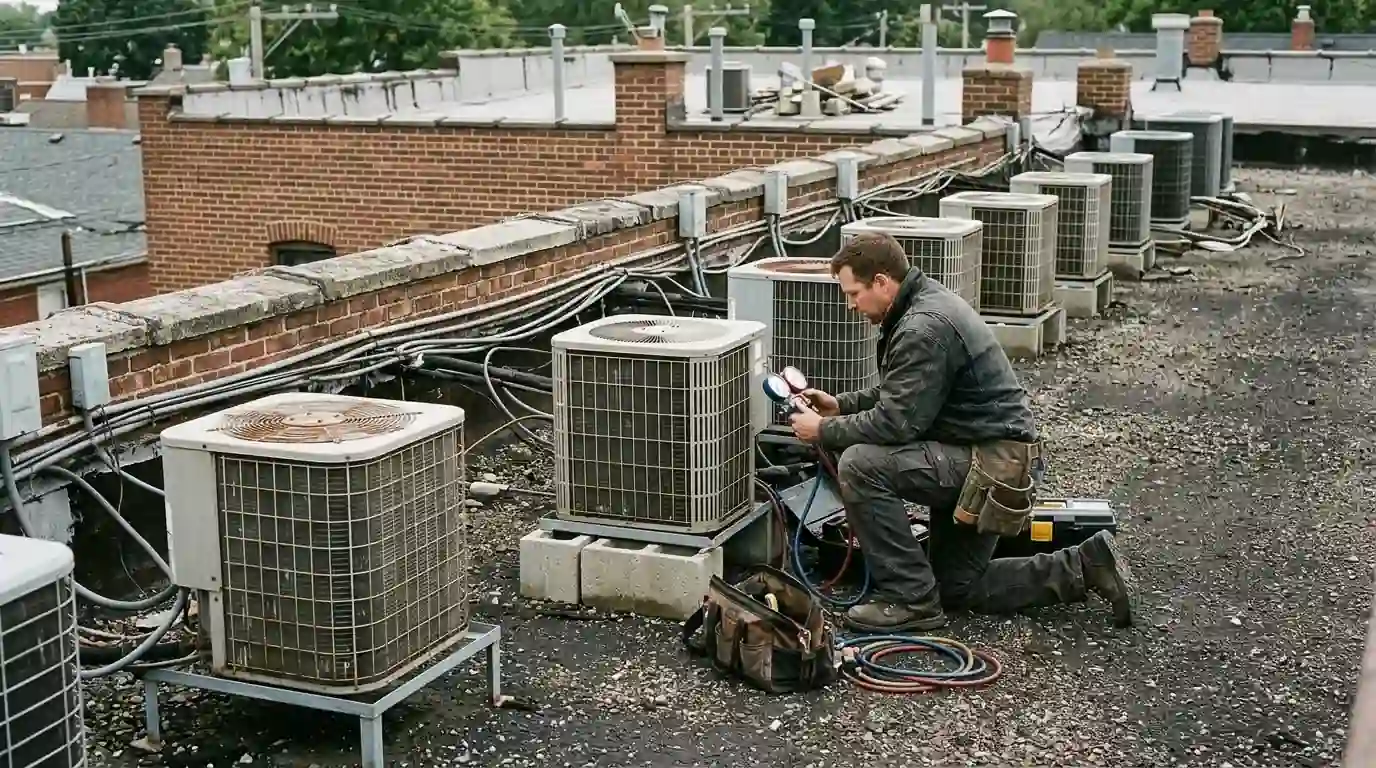
Our base in West Deptford is on the New Jersey side of the river, and the Walt Whitman Bridge, one of the Delaware River Port Authority's bridges, comes down in South Philadelphia. That puts corner restaurants, shops and walk-up apartment buildings there on a direct route, along with businesses in Gloucester City on the Jersey side. Many commercial calls on that route are small buildings: a rooftop unit or two over a storefront, a boiler under a few floors of apartments, a kitchen that cannot close for a day.
How a commercial repair visit runs
Get the story from staff
Which areas are affected, when it started, any error codes, and what was already reset.
Check power and controls
Voltage on every leg at the disconnect, the thermostat or controller call, fuses and safeties.
Test the failed circuit
Ignition and flame proof, or pressures, superheat, subcooling and compressor amperage, depending on the call.
Repair and run it
We replace or clean the failed part and run the unit through a full cycle.
Tell the person in charge
What failed, what we did, and anything else on the unit that is close to failing.
How long a commercial repair keeps you down
Contactors, capacitors, fuses, belts and most ignition parts are common across brands, so those repairs usually get the unit running on the first visit. Many condenser fan motors fall in the same group.
Compressors, control boards, heat exchangers and model-specific motors may have to be ordered. When that happens we say so on the first visit and keep any stages that still work running while the part comes in.
What sets the price of a commercial repair
You see the price before we start. What moves it:
- Which part failed: a contactor or belt versus a compressor or heat exchanger
- Roof access: interior hatch, ladder or a lift
- Refrigerant type and how much the circuit needs after a leak repair
- Whether the work has to happen outside business hours
- Carrier
- Trane
- Lennox
- Rheem
- Goodman
- York
- Bryant
- American Standard
- Mitsubishi Electric
- Daikin
- Fujitsu
- Weil-McLain
- Burnham
We repair commercial equipment from Carrier, Trane, Lennox, York, Daikin and Mitsubishi Electric, plus older rooftop units still in service.
Usually, yes. Most rooftop work happens outside the space. When power or gas inside has to be shut off, we tell the manager first and keep the shutdown short.
It depends on what failed and on the heat exchanger, compressor and cabinet. A burned contactor on a sound unit is worth fixing. A dead compressor on an aging R-22 unit often is not.
Common causes are a shorted compressor winding, a failing condenser fan motor, loose lugs, or a lost phase on three-phase power. Repeated resets can damage the compressor, so leave it off and call.
Yes. We repair central boilers and individual apartment systems. Let tenants know a tech may need to enter, and have keys to the boiler room and the affected units ready.
Yes. We check the burner, the blower and belt, the filters, and the interlock that starts makeup air with the hood exhaust. Grease duct cleaning is a separate trade.