HVAC Resources
Why dryer vents clog in Philadelphia rowhomes, and the signs to watch
Long basement runs, crushed foil ducts and roof terminations make rowhome dryer vents clog sooner than most. Here is how to spot a blocked vent before it turns into a hazard.
By Lois Cavanaugh, HVAC Guides EditorUpdated October 2026
Short answer
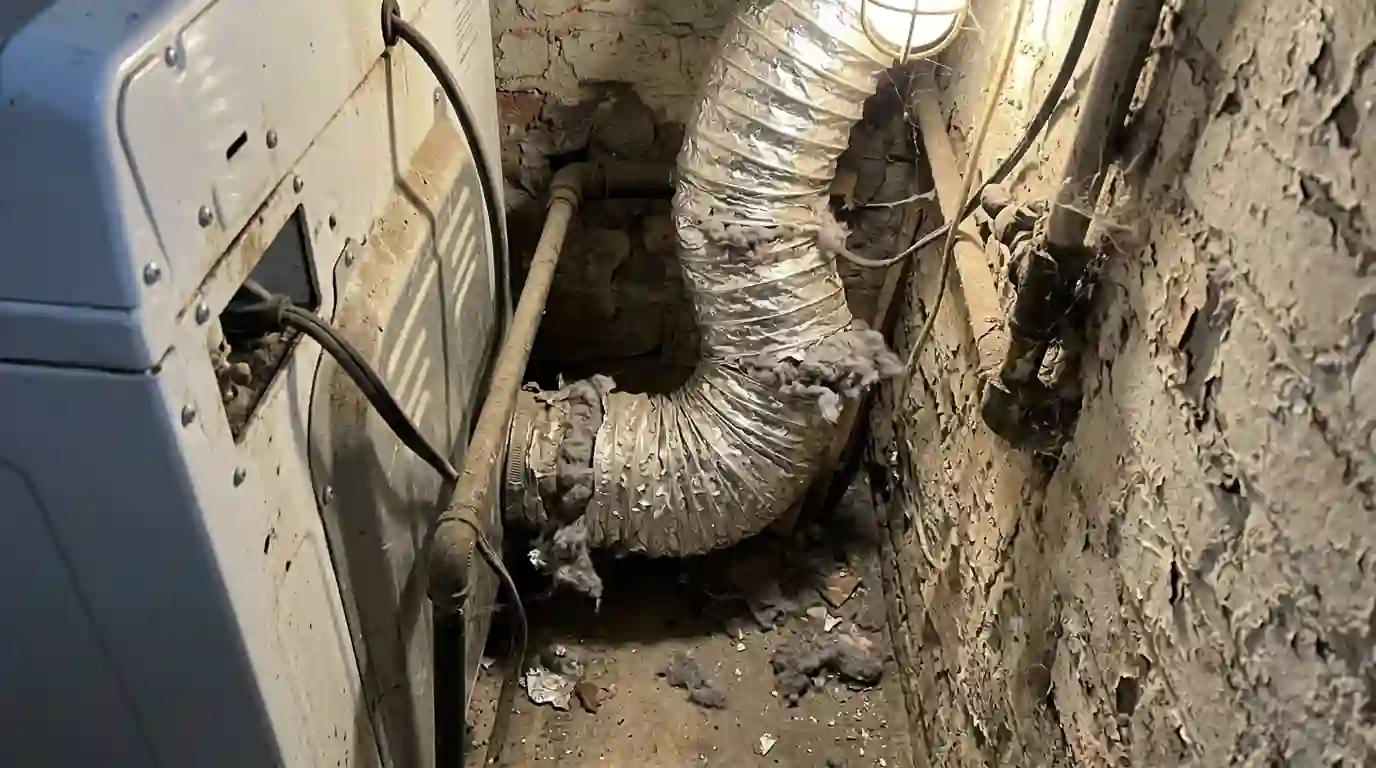
Rowhome dryer vents clog because the dryer usually sits in a basement or an interior closet, far from an outside wall, so the vent runs long with several bends, often across a ceiling or up to the roof. Lint settles at every elbow and sag. Longer drying times come first; heat, humidity and a scorched smell come later.
Why the layout of a rowhome works against the dryer
In a detached house, the dryer usually sits against an outside wall and vents a short distance straight out. Rowhomes rarely allow that, and many dryers went in decades after the house was built, wherever the hookups would fit. Party walls on both sides leave the front and rear as the only outside walls, so a basement dryer often vents through a long run between the ceiling joists to the back of the house, and a laundry closet on an upper floor may vent up through the roof.
Every foot of duct and every elbow slows the air, and slower air drops lint. Dryer manufacturers publish a maximum vent length for each model, with each elbow counting as extra length. Long rowhome runs can approach or pass that limit before anything is clogged, which is exactly why they clog sooner.
Roof terminations add their own trouble. Lint collects in the cap, birds nest in it, and some caps carry screens that should never be on a dryer vent, because a screen catches lint by design. A roof vent is also out of sight, so nobody notices it closing up.
The signs, from the laundry room to the outside hood
A clogging vent shows up slowly, so the signs are easy to explain away as an old dryer or a heavy load. Watch for these:
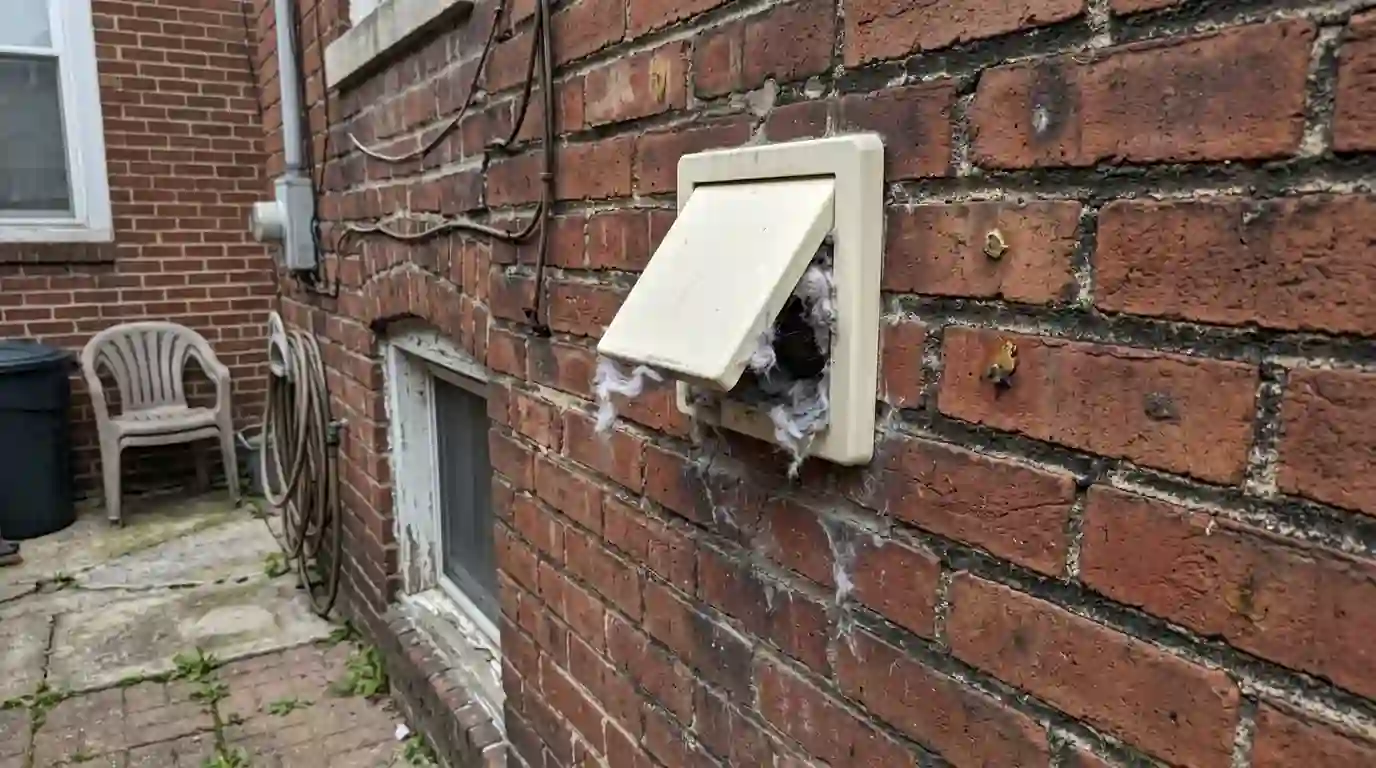
Check the outside hood while the dryer runs on a heat setting. You should feel strong, warm air and see the flap open fully. On a roof vent you may not be able to check safely, which is part of why roof runs go years without anyone looking.
- A normal load needs a second cycle to dry
- The top of the dryer or the clothes feel hotter than they used to
- The laundry room turns humid, or a nearby window fogs while the dryer runs
- A musty or scorched smell during or after a load
- Weak airflow at the outside hood, or a flap that barely lifts
- Lint gathering around the outside hood or on the wall below it
Why a clogged vent is a fire and carbon monoxide risk
Lint is dry, fine and burns easily. When the vent restricts airflow, the dryer runs hotter, and its high-limit thermostat starts cycling the heat off and on to protect itself. Lint near the heater, or caught in a hot spot of the duct, can ignite. A dryer that keeps blowing its thermal fuse is telling you the exhaust is blocked, and a new fuse does not fix that.
Gas dryers add a second concern. Their exhaust carries combustion gases, including carbon monoxide, out with the moist air. A blocked or disconnected vent can push that exhaust into the basement or the laundry closet instead. A carbon monoxide alarm near the laundry area and on each sleeping floor is worth having in any house with a gas dryer.
Never run the dryer with the duct pulled off to vent into the basement, even for a load or two. On a gas dryer that is an exhaust leak by definition. On an electric dryer it fills the basement with lint and moisture that settle on the furnace, the water heater and the wiring.
Dryer running hot or smelling scorched? Call (267) 392-1418 any hour; a person answers.
Call (267) 392-1418The duct materials behind most clogs
Much of what we find behind rowhome dryers is the wrong duct. White vinyl flex should never carry dryer exhaust, since it melts and burns. Thin foil accordion duct crushes when the dryer is pushed back, and its ridges hold lint. Even semi-rigid aluminum belongs only in the short connector between the dryer and the wall, not strung across a basement ceiling.
The run itself should be smooth-wall rigid metal, with each joint lapped so the air flows over the seam rather than into it, and sealed with foil tape rather than screws. Screws that poke into the duct snag lint and start a clog. The run should be supported along its length, because a sag collects lint and, in cold weather, condensation that turns the lint to paste.
The termination matters as much as the duct. A wall hood should have a light flap or louvers that close when the dryer stops and open fully under airflow, with no screen. A flap painted shut, bent or packed with lint holds back exhaust on every load. Hoods close to the ground on a back patio can also get blocked by snow, leaves or a grill cover pushed against the wall.
Dryer vent care you can do yourself
Most routine care is easy and safe, and it does more than people expect.
Unplug an electric dryer before pulling it out. On a gas dryer, move it gently so the gas connector is not strained, and if that connector looks old, stiff or kinked, leave it alone and have it checked.
- Clean the lint screen before every load
- Wash the screen with soap and water now and then if you use dryer sheets, since the residue can clog the mesh
- Pull the dryer out and check the connector duct for crushing or kinks
- Vacuum lint from the screen housing and both ends of the connector
- Keep the outside hood clear of lint, leaves and nests you can reach from the ground
When cleaning the vent is a job for a tech
A long run hidden in a finished ceiling, a vent that goes up to the roof, a duct that has come apart inside a wall, or a dryer that still runs hot after the connector is clean all need tools and access most homeowners do not have. A thorough cleaning runs rotary brushes and a vacuum through the full length, from the dryer to the termination, then checks airflow at both ends.
We also look at the route itself. Sometimes a run can be shortened, an elbow taken out, or a screened roof cap swapped for one made for dryer exhaust. Our dryer vent cleaning page explains what a visit includes.
After any cleaning, the test is simple: a normal load should dry in one cycle again, and the air at the outside hood should feel strong and warm. If it does not, something is still wrong in the run, often a crushed section hidden in a ceiling or a disconnected joint dumping lint inside a wall.
A damp laundry room is not always the dryer
If the dryer vent tests clear and the laundry area or the bathroom next to it still stays damp, the moisture may be coming from somewhere else. In older rowhomes, bathroom fans are sometimes ducted into the same chase as the dryer, or simply dump into the ceiling space instead of reaching outside. Moist air left inside the house feeds mold and peeling paint. A bath fan needs its own duct to the outdoors and should never tie into the dryer line. See bathroom exhaust fan installation for how we run them.
It depends on the length of the run and how much laundry the house does. Long runs and roof vents clog faster. If drying times start creeping up, it is due, whatever the calendar says.
It can push loose lint out of a short, straight run. In a long rowhome run it can blow joints apart or pack lint tighter into an elbow, so those runs need brushing.
Thin foil accordion duct crushes and traps lint. Use smooth rigid metal for the run, keep any flexible connector short, metal and uncrushed, and check the dryer manual for what it allows.
Usually because the exhaust is restricted and the dryer overheats. Replacing the fuse without clearing the vent just sets up the next failure, so have the vent checked first.
Yes. A blocked or disconnected vent can spill exhaust into the house. Keep a carbon monoxide alarm near the laundry area and have the vent checked if the dryer runs hot.
Keep reading
Related services and guides
Dryer Vent Cleaning
Lint cleared from long vent runs and roof exits.
Bathroom Exhaust Fan Installation
Quiet fans vented outside so bathrooms dry out.
Water Heater Warning Signs Before It Leaks
How to read rust, rumbling, drips and pilot trouble on a tank water heater before it floods the basement.
Choosing an HVAC Contractor in Philadelphia
The questions that separate HVAC quotes in Philadelphia: permits, load calculations, written scope and who does the work.